 Assisted Reproduction Center
IVF with Egg Donation
The desire to experience the joy of pregnancy and the bond that forms between a mother and her child during pregnancy is powerful and natural.
 Assisted Reproduction Center
Women's eggs are fascinating cells that, once fertilized, allow for the creation of a new life. Girls are already born with several million immature eggs, an ovarian reserve that naturally decreases, with the loss accelerating when they reach their thirties. As the quantity of eggs decreases, so does their quality: Age directly affects the ability of each egg to become a viable embryo and then a baby.
However, thanks to In Vitro Fertilization with donor eggs, hundreds of thousands of women and couples around the world have been able to continue growing their families despite having depleted their own ovarian reserve. This technique has advanced significantly, and currently the treatment itself is not particularly complex for the recipient, but it does often provoke emotions that must also be taken into account before starting it.

This treatment is recommended when:


The chances of pregnancy offered by IVF with egg donation are the highest among all Assisted Reproductive Technology treatments.
In 71% of cases, we achieve pregnancy on the first transfer attempt. After the second attempt, the probability of pregnancy is 91%. After three attempts, this probability is 98%.
In some Assisted Reproduction centers, a specific number of eggs per treatment is still proposed. But nowadays, in the most advanced clinics, we go one step further and offer you the guarantee that you will have a specific number of blastocysts.
We call a blastocyst the embryo that we have been able to monitor its development for five days until it is in its pre-implantation stage in the future mother's uterus. That is, we know that its morphology, maturation, and evolution have been correct. The sum of these factors is indicative of a good prognosis.
In the traditional approach, having a specific number of eggs does not guarantee that you will have one or more viable embryos, as not all eggs survive laboratory procedures. In fact, naturally, only 50% of embryos reach the blastocyst stage.
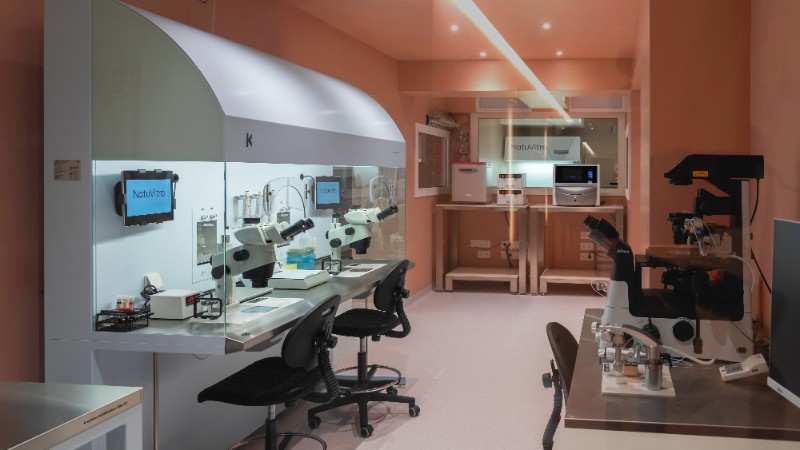
In other words, at NatuVitro, we will have used all the eggs that have been necessary to guarantee you a specific number of blastocysts for transfer. Depending on the treatment, we vitrify the blastocysts that we do not implant in the first attempt at -196 degrees so that they remain intact and available for when you need them.
The cost of your treatment will depend on your diagnosis and preferences. In the following table, you can see the different options we can offer you. During your first visit with your doctor, you will evaluate which is the best treatment for you, and together you will adapt it to your personal situation.
Remember that if you are a resident in Spain, you can finance up to 100% of the total cost of the treatment, including medication.

According to Spanish law, egg donation, like any organ or biological tissue donation, is anonymous and altruistic. This means that neither the donor nor the recipient can know the identity of the other person. Once you are known to your doctor at NatuVitro, along with your partner if you have one, and your donor, it will be your doctor's responsibility to ensure the maximum compatibility between both parties, as well as the safety and well-being of both.
Hundreds of thousands of women and couples from all over the world have made the same decision at some point, and today they are happy mothers. Here are some of their comments:
"My first reaction upon hearing the diagnosis was shock. It gave me the feeling that we were bringing a third person into our relationship, and I think that's what made me shut down. I was chatting with dozens of women who were in the same situation, and little by little I realized that this cell was nothing more than a tiny part of the future baby that was about to come. I remember that morning was sunny, we called the clinic to start the treatment. Today, when I see my daughter sleeping peacefully, I am grateful to that unknown girl who gave me the key to the best treasure I had ever dreamed of."
"The first time I heard about egg donation in class, I thought, oh, but I'm not even considering becoming a mother yet. This doesn't apply to me! But one day, while talking about it with a friend, I realized that I had the possibility to help a woman who was trying to conceive. Giving an egg is not giving a child, I don't see it that way. For me, giving an egg is giving happiness to someone. Many times, I think about that woman and that family. I am very proud to have helped them, and I would do it again."
Our experts are ready to examine your case history, clarify your choices, and address every question you have.
Don't wait to make informed decisions – your personalized guidance awaits!